Khalsa Chiropractic
Safe Back Exercises: The Extensors
To fully recuperate from an acute back pain episode and prevent future disabling episodes improving your spinal fitness is essential. Even when in acute pain try to resume normal activities as soon as possible. Your health care professional will give you advice about key activity modifications for such tasks such as sitting, bending, lifting, etc. Maintaining physical functioning is the key to recovery of low back episodes.
One of the most frequent factors associated with low back trouble is muscle weakness or ‘deconditioning’. A few simple back exercises have been proven to be safe and effective. This program should begin once your acute low back pain begins to settle.
Along with basic postural advice the key to protecting your back is 360° of muscle support. Many programs emphasize only the abdominal muscles which is a big mistake. The back and side muscles are at least as important. Presented here are a few progressions which isolate your back muscles. These include both the deep and superficial back extensor muscles.
Cat/Camel
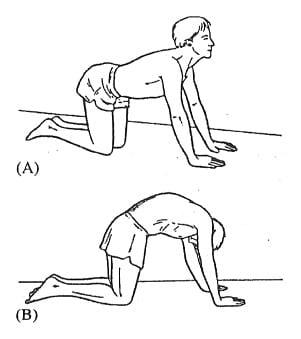
First, begin with a simple warm-up involving the cat/camel exercise on all fours (Figure 1). This should be performed first thing in the morning and then prior to your training exercises. 8–10 slow repetitions are all that are needed. Think of the cat/camel as a limbering, rather than stretching movement.
Quadruped Single Leg Raise
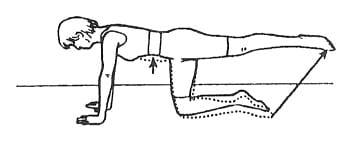
After performing the cat/camel you are ready for a simple exercise which will begin to improve the endurance of your back muscles. This is called the quadruped single leg raise (Figure 2). While positioned on all fours extend one leg behind you as far as you can while gradually raising it up until it is level with your waist. Try to keep your back and abdominal muscles tightened and your pelvis squared off during this maneuver. Start with 3–4 repetitions and progress until you can perform 10–12 repetitions while holding each rep for 5–6 seconds. This routine should be performed once or twice a day.
Common Errors to Avoid
- Arching the low back
- Rotating your spine or pelvis
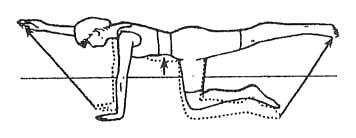
The next progression is to perform this by raising your opposite arm and leg (Figure 3).
Always, remember if you are experiencing discomfort the cat/camel is your ‘first-aid’ exercise, retreat to it. A little bit of discomfort with the quadruped exercise is all right as hurt does not necessarily equal harm. The road to recovery is through activity. If your back is giving you trouble it is a sign that it is not strong or supple enough to do the work that is required. The cat/camel and quadruped exercises are safe for your back and will help you to recondition the ‘weak link’.
C. Liebenson, “Safe back exercises: the extensors,” Journal of Bodywork and Movement Therapies 4(4):250, 2000. Reproduced with permission.