Healthy Life Newsletter, May 2021
The Last Profession Standing for Low Back Pain: Chiropractic
By Donald M. Petersen Jr., BS, HCD(hc), FICC(h)
In the research world, low back pain has become the benchmark for effectiveness, as there are significantly more studies on LBP than any other musculoskeletal ailment. The studies we have seen over the past several years read like the makings of a great detective novel.
But instead of trying to discover “who done it,” science has been eliminating the usual suspects in an effort to unveil “who should do it.”
Ruling Out PTs or DOs
A study published last August eliminated two professions from the lineup. The randomized, controlled trial revealed that “[neither] spinal manipulation nor mobilization appeared to be an effective intervention for young adults with mild to moderate chronic low back pain.” While this may be unsettling on its face, it should be noted that “all treatments” were provided by “either a doctor of osteopathic medicine or physical therapist.”(1)
It’s Not MDs, Either
The most recent study narrows down the virtual last profession standing. In their efforts to better understand the risks associated with patients’ transition from acute to chronic LBP, a research team at the University of Pittsburgh discovered that almost half (48 percent) of medical patients received “nonconcordant care” or care not consistent with established guidelines. The researchers’ work demonstrated that “exposure to nonconcordant care was associated with increased odds of developing chronic LBP.”(2)
In essence, the nonconcordant care provided by the medical physicians during the first 21 days of care increased the patient’s chances of transitioning from acute to chronic. Not surprisingly, the most common form of nonconcordant care involved drugs. Almost a third, (30 percent) “received prescriptions for nonrecommended medications,” of which almost two-thirds (65 percent) received opioids.
Health Payers Are Noticing
The above is not lost on health payers, who enjoy the ability to analyze large data to better understand what works. Two years ago, David Elton, DC, senior VP of clinical programs at OptumHealth, gave a powerful presentation in which he outlined the most effective care for their insureds. Dr. Elton noted, “The pathway that’s most aligned with all prevailing guidelines [is] when patients start with chiro / PT / acupuncture. … You receive the services you should, you avoid the services you shouldn’t, imaging is aligned, total episode cost is lowest. … The actuaries have done the work, it’s presented at the actuarial conference, the net of the increased conservative care will take out about 230 million in annual medical expenditures and reduce opiate prescribing for back pain by 25-26 percent.”(3)
The Last Profession Standing: Chiropractic
So, what’s the problem? Why aren’t almost all acute spine cases seen by doctors of chiropractic? (Not that this is the only benefit to chiropractic care.)
More than 30 years ago, United States District Judge Susan Getzendanner held that “the conduct of the [American Medical Association] and its members constituted a conspiracy in restraint of trade based on the following facts: the purpose of the boycott was to eliminate chiropractic; chiropractors are in competition with some medical physicians; the boycott had substantial anti-competitive effects; there were no pro-competitive effects of the boycott; and the plaintiffs (chiropractors) were injured as a result of the conduct.” Old prejudices die hard. I believe the impact of this effort is still influencing referral decisions today.
Based on these and multiple earlier studies, chiropractic is the only profession left standing for effective LBP care, both acute and chronic. And while this distinction minimizes the impact chiropractic care has on the rest of the spine, the entire musculoskeletal system and ultimately, total wellness, it does present providers and payers with a clear choice.
But as this most recent study demonstrates, many providers, particularly medical doctors, are still choosing nonconcordant care in place of guideline-directed chiropractic care. You can change all that – by visiting your doctor of chiropractic regularly for low back pain; and always requesting you see a chiropractor if your medical doctor suggests otherwise.
References
Thomas JS, Clark BC, Russ DW, et al. Effect of spinal manipulative and mobilization therapies in young adults with mild to moderate chronic low back pain: a randomized clinical trial. JAMA Netw Open, 2020;3(8):e2012589.
Stevans JM, Delitto A, Khoja SS, et al. Risk factors associated with transition from acute to chronic low back pain in US patients seeking primary care. JAMA Netw Open, 2021;4(2):e2037371.
The Role of Nonpharmacological Approaches to Pain Management: Proceedings of a Workshop. National Academies of Sciences, Engineering and Medicine, 2019.
Why Magnesium Levels Decline with Age & What to Do About It
By Jennifer Chesak
:
Magnesium is required for a whole lot of chemical reactions in the body. The mineral plays a role in blood sugar and blood pressure management, muscle and nerve transmission, the transport of other nutrients, and immune system support.* Magnesium is also paramount to the health of our bodily structures—from our bones down to the tiny mitochondria in our cells.
Magnesium is a macromineral, meaning we need much more than trace amounts to keep our bodies running smoothly. But unfortunately, many of us have low levels of magnesium, a problem that can worsen as we get older.
Why magnesium levels often decline with age.
Getting enough magnesium through diet alone is challenging at any age. Soil depletion in farming has resulted in a steady decline of magnesium in the foods we eat. And food processing results in a loss of the mineral as well, according to a review in the journal Nutrients. These days, at least 60% of people in the United States don’t get the recommended daily amount of magnesium through foods.
So what does aging have to do with it? “As a person ages, a big factor in their magnesium decline is because their appetite and intake also decline,” explains Christina Fitzgerald, M.S., R.D., a registered dietitian and sports nutrition expert. “So they’re taking in much less dietary magnesium.”
Plus, aging involves a lot of changes within the body that can affect magnesium levels: “Three of the most common reasons magnesium insufficiency is seen in the aging population are reduced intestinal absorption, reduced bone store, and excess urinary loss,” says Alex D’Elia, R.D., a functional registered dietitian in New York City.
Physician Bindiya Gandhi, M.D., adds that some prescription medications can also contribute to magnesium depletion, including antibiotics, diuretics, proton pump inhibitors, and certain drugs used to treat osteoporosis.
Read the rest of this article, including what to do about it, at mindbodygreen.com
A Drug-Free Way to Treat Headaches: Chiropractic Care
By Perry Nickelston, DC, FMS, SFMA
More Americans complain about headaches than any other health condition, including back pain; in fact, approximately 45 million Americans say they suffer headaches each year.
That’s one in every six people or more than 16 percent of the population. More than 8 million Americans visit their doctor seeking relief for symptoms of headaches each year. Unfortunately, the most popular treatment is over-the-counter pain relievers or prescription medication.
There is some good news when it comes to headaches. There are safe and effective natural solutions available to help reduce or eliminate the symptoms of various headache types. For example, chiropractic treatment is a highly sought-after alternative treatment for the debilitating effects associated with headaches. Let’s learn about that headache you may be suffering from and how chiropractic can help you get rid of it.
Headaches 101
Tension headaches: The most common type of headache is the tension headache. It is estimated that 80-90 percent of the U.S. population suffers from tension headaches at some point in their lives. There are two primary types of tension headaches:
Episodic: Headaches appear occasionally, usually less than 15 times per month.
Chronic: Headaches occur more than 15 times per month or on a consistent basis.
Tension headaches are intimately connected to abnormal posture, muscular tightness, joint stiffness, and restricted range of motion in the body. To obtain optimum health and function, it is important to remember that everything is connected and everything matters. Dysfunctional patterns of movement and posture affect how much tension and stress your body holds. The body must compensate for these dysfunctional patterns by any means necessary, and it accomplishes this by altering tension points.
Muscles attach to anchor points on bone and act as primary movers and stabilizers for your body. Mover muscles are used get you from point A to point B, such as a getting up out of a chair. Stabilizer muscles control that movement so you don’t fall down while standing up. Abnormal posture and altered tension points on bone anchors puts too much wear and tear on muscles and joints. Your brain and nervous system must compensate for this dysfunction by altering blood flow, muscle movement patterns and breathing. These alterations often lead to tension headaches.
Migraines: The second most common type of headache is the migraine headache. Approximately 16-17 percent of the population complains of migraines. These headaches are far more debilitating than the tension-type headaches. More women than men suffer from migraine headaches, leading researchers to believe there may be a hormonal component to migraines. The majority of migraine sufferers report some sort of trigger that kicks of their headaches (food, drink, smell, etc).
How Chiropractic Can Help
Chiropractic care can help alleviate the symptoms of tension and migraine headaches by improving and restoring normal postural patterns. Chiropractic treatment is aimed at normalizing muscle tension, restoring joint range of motion, and stabilizing the body to reduce abnormal stressors. Optimizing postural control of the head and neck reduces the workload your muscles must apply just to keep your head up during the day. Proper spinal alignment and muscle control helps give the body a fighting chance of avoiding a tension headache.
Proper breathing is essential to relaxation, blood flow, and oxygen supply to the brain and body. Abnormal posture, which can include such dysfunctions as rounded shoulders, neck forward over the shoulders, slouched positions and tightness in the hips from sitting all day, decrease lung capacity. This decreased capacity alters how much you breathe, how often, and from where.
Headache sufferers tend to breathe more from their chest and shoulders as opposed to their diaphragm. This leads to repeated elevation of the shoulders and upper back muscles hundreds of times a day, leading to increased tension in the head and neck. Chiropractic restores function to the spine, ribs, and hips to maximize breathing and good postural control. Better breathing equals better health.
If you’re suffering from headaches and are tired of taking pain-relieving medication day after day, your doctor of chiropractic will work closely with you to determine likely triggers for your headaches and make subtle changes in your activities of daily living to empower you to take back control of your life.
(Note from Dr. Mha Atma about article below: This was written for doctors of chiropractic to read, but it’s pretty easy to understand and I thought you would find it helpful.)
Muscle Relaxants vs. Manipulations for Low Back Pain
By Ronald Feise, DC
Your patient’s medical doctor recommended skeletal muscle relaxants for his acute low back pain, but the patient does not want to take medication. He is a delivery person who had a bad reaction to skeletal muscle relaxants in the past. How should you respond to your patient’s concerns? What does the current research say?
Skeletal muscle relaxants have been on the market for more than 40 years and have recently become more popular. The number of prescriptions has doubled in the past decade, and now over 30 million prescriptions are written annually in America. More than half of these prescriptions are directly related to back pain.1 Moreover, these drugs have disproportionately high use by older adults, a population in which muscle relaxant use is potentially inappropriate.
Muscle Relaxants vs. Manipulations
Today we compare the benefits of muscle relaxants with those of chiropractic manipulations. A randomized, double-blind clinical trial has tested the efficacy of chiropractic manipulation, muscle relaxants and placebo for subacute low back pain.2 This study was published in the Journal of Manipulative and Physiological Therapeutics. The research team consisted of four chiropractors, two PhDs and one MD.
More than 190 patients experiencing low back pain of 2-6 weeks’ duration were randomly allocated to three intervention groups: chiropractic manipulations with placebo medicine, muscle relaxants with sham manipulations, or placebo medicine with sham manipulations.
The bar graph titled, “Improvements in Pain” demonstrates this study’s conclusions. This graph shows the effect size of treatments for pain. “Effect size” is a measure of treatment benefit. The larger the effect size, the better the result.
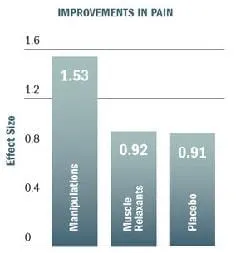
Chiropractic manipulations were 49 percent more effective than muscle relaxants or placebo for reducing pain. Note that muscle relaxants were not even better than placebo. These findings hold true at different measurement times and also apply to patient function.
Additional Research on Muscle Relaxants for Acute Low Back Pain
The early clinical trials for muscle relaxants found modest improvements in pain and function, but these studies were of poor quality. In 1988, a randomized, clinical trial found muscle relaxants had no effects superior to placebo.3 Then in 2011, another research team found different results. In a pharmaceutical industry-led clinical trial, researches found a 24 percent improvement in pain with muscle relaxants compared to placebo.4 (It is important to note that these findings have never been duplicated.)
Recently, a research team conducted a systematic review and meta-analysis to investigate whether including unpublished quality randomized, clinical trial data changed the benefits for patients with low back pain. They found that the addition of unpublished quality data reduced the benefit of muscle relaxants for acute low back pain. The benefit, originally published as 22 percent improvement, was reduced to 2 percent when that data was added.5
Another research team conducted a prospective analysis of four quality randomized, placebo-controlled studies to determine the effects of seven popular skeletal muscle relaxants (baclofen, metaxalone, tizanidine, diazepam, orphenadrine, methocarbamol, and cyclobenzaprine) in patients with acute low back pain.6 This research team discovered that patients with acute LBP who are treated with these skeletal muscle relaxants do not experience outcomes better than placebo.
In light of the latest research, there is currently a lack of evidence to support the use of muscle relaxants for acute low back pain.
Muscle Relaxants for Chronic Low Back Pain or Sciatica
The U.S. Department of Health and Human Services sponsored a systematic review that investigated the effects of muscle relaxants on patients with chronic low back pain.7 The research team found no evidence that muscle relaxants were consistently better than placebo. Additionally, there is no research demonstrating benefits of muscle relaxants for patients with sciatica.
Not Just Ineffective – Dangerous
Numerous adverse reactions are associated with muscle relaxants. In particular, skeletal muscle relaxants are associated with heart failure, paralysis, difficulty breathing, tachycardia, chest pain, sudden numbness or weakness, sudden headache, confusion, fainting, weakness, lack of coordination, hallucinations and problems with vision, speech, or balance.
Multiple clinical trials have found that skeletal muscle relaxants are associated with 50 percent more total adverse events and 104 percent more central nervous system adverse events than placebo.8 In a nationwide case-control study of Medicare patients, the use of skeletal muscle relaxants was associated with a 40 percent increase in fracture risk.9
Since 2004, there has been an 84 percent increase in skeletal muscle relaxant involvement in suicide attempts.10 Furthermore, among patients who were already taking muscle relaxants at the time of their doctor visit, 67.2 percent were concomitantly treated with an opioid – a combination known to cause serious drug-drug interactions and an increased risk of opioid overdose.1
Based on the lack of evidence regarding the long-term safety of muscle relaxants and their risk of abuse, guideline recommendations limit the use of these drugs to a maximum duration of 1-2 weeks.1 Despite these recommendations, a study found that 44.5 percent of people taking muscle relaxants were continuously treated with these drugs for longer than one year.11
Our Opportunity
The results of this research present an opportunity. Medical doctors and their patients will be searching for effective and safe alternatives. Evidence-based chiropractors will be welcomed. Additionally, insurance companies should notify patients and medical providers that they will no longer pay for muscle relaxants, because they are ineffective and unsafe for back pain.
Author’s Note: The research presented in this article is also available in video format at chiroevidence.com.
References
Soprano SE, Hennessy S, Bilker WB, Leonard CE. Assessment of Physician Prescribing of Muscle Relaxants in the United States, 2005-2016. JAMA Netw Open 2020;3:e207664.
Hoiriis KT, Pfleger B, McDuffie FC, Cotsonis G, Elsangak O, Hinson R, Verzosa GT. A randomized clinical trial comparing chiropractic adjustments to muscle relaxants for subacute low back pain. J Manipulative Physiol Ther 2004;27:388-98.
Berry H, Hutchinson DR. A Multicentre Placebo-Controlled Study in General Practice to Evaluate the Efficacy and Safety of Tizanidine in Acute Low-Back Pain. Journal of International Medical Research 1988:75-82.
Chandanwale, A.S., Chopra, A., Goregaonkar, A., Medhi, B., Shah, V., Gaikwad, S., Langade, D.G., Maroli, S., Mehta, S.C., Naikwadi, A., Pawar, D.R. (2011). Evaluation of eperisone hydrochloride in the treatment of acute musculoskeletal spasm associated with low back pain: A randomized, double-blind, placebo-controlled trial. J Postgrad Med 2011;57:278–285.
Bagg MK, O’Hagan E, Zahara P, Wand BM, Hubscher M, Moseley GL, McAuley JH. Systematic reviews that include only published data may overestimate the effectiveness of analgesic medicines for low back pain: a systematic review and meta-analysis. J Clin Epidemiol 2020;124:149-159.
Abril L, Friedman B. The Efficacy of Skeletal Muscle Relaxants in Emergency Department Patients With Low Back Pain. Albert Einstein College of Medicine. American College of Emergency Physicians (ACEP) 2020: Abstract 15. 2020.
Chou R, Deyo R, Friedly J, Skelly A, Hashimoto R, Weimer M, Fu R, Dana T, Kraegel P, Griffin J, Grusing S, Brodt E. Noninvasive Treatments for Low Back Pain. Comparative Effectiveness Review No. 169. AHRQ Publication No. 16-EHC004- EF. Rockville, MD: Agency for Healthcare Research and Quality; February 2016.
van Tulder MW, Touray T, Furlan AD, Solway S, Bouter LM. Muscle relaxants for non-specific low back pain. Cochrane Database Syst Rev. 2003: CD004252.
Witenko C, Moorman-Li R, Motycka C, et al. Considerations for the appropriate use of skeletal muscle relaxants for the management of acute low back pain. P & T : a peer-reviewed journal for formulary management. 2014;39(6):427-435.
Substance Abuse and Mental Health Services Administration, DrugAbuse Warning Network, 2011: National Estimates of Drug-Related Emergency Department Visits. HHS Publication No. (SMA) 13-4760, DAWN Series D-39. Rockville, MD: Substance Abuse and Mental Health Services Administration, 2013.
Dillon C, Paulose-Ram R, Hirsch R, Gu Q. Skeletal muscle relaxant use in the united states: Data from the third National Health and Nutrition Examination Survey (NHANES III). Spine (Phila Pa 1976) 2004;29:892-896.
Steroids for Sciatica: More Trouble than They’re Worth
By Deborah Pate, DC, DACBR
Use of epidural steroid injections has increased dramatically in recent years, despite the fact that studies have failed to demonstrate evidence this procedure is clinically helpful (while other studies suggest it may actually be dangerous).
Considering that lack of evidence – not to mention the terrible 2012 outbreak of fungal meningitis / infections caused by contaminated vials used for epidural corticosteroid injections – it is prudent at least to take a critical look at this procedure as it relates to sciatica or pain affecting the sciatic nerve, which extends from the lower back down the back of each leg.
Small Relief, Big Potential Side Effects
In a recent meta-analysis of 23 randomized trials involving more than 2,000 patients in which epidural steroid injections were compared with placebo for sciatica, epidural steroid injections produced small, statistically insignificant short-term improvements in leg pain and disability (but not less back pain) compared to placebo. This improvement also was only over a short period of time – two weeks to three months. Beyond 12 months, there was no significant difference between groups.
Besides infection, there are other side effects associated with epidural steroid injections: bleeding, nerve damage and dural puncture. Then there are side effects associated with the steroid medication, which include the following: a transient decrease in immunity, high blood sugar, stomach ulcers, cataracts and increased risk of fracture.
This last complication is certainly not emphasized in clinical circles. Therapeutic steroids may reduce pain, however the use of steroid injections seem to promote deterioration of skeletal quality, which is not surprising since other forms of steroid medication have long been associated with osteoporosis.
A retrospective study published in the Journal of Bone and Joint Surgery looked at lumbar epidural steroid injection (LESI), and the potential impact on bone fragility and vertebral fractures (spinal fractures). Researchers identified a total of 50,345 patients who had medical diagnosis codes involving the spine; within that group, a total of 3,415 patients had received at least one LESI.
Three thousand patients were randomly selected from the 3,415 injected population and 3,000 additional patients were selected from the non-injected group as a control group. There was no significant difference between the injected and non-injected groups with respect to age, sex, race, hyperthyroidism or corticosteroid use.
When incidence of vertebral fractures was assessed, researchers discovered that an increasing number of injections was associated with an increasing likelihood of fractures, and each successive injection increased the risk of spinal fracture by 21 percent. Based on this evidence, LESIs clearly exacerbate skeletal fragility. They promote deterioration of skeletal quality similar to the use of exogenous steroids, which is the leading cause of secondary osteoporosis. In fact, the rate of vertebral fracture following epidural steroid injections may be underestimated.
Both European and American guidelines, based on systemic reviews, conclude that epidural corticosteroid injections may offer temporary relief of sciatica, but do not reduce the rate of subsequent surgery. This conclusion is based on multiple randomized trials comparing epidural steroid injections with placebo injections, and monitoring of subsequent surgery rates. Facet joint injections with corticosteroids seem no more effective than saline injections.
Rising Costs, Limited Benefits
Despite the limited benefits of epidural injections, Medicare claims show a 271 percent increase during a recent seven-year interval. Earlier Medicare claims analyses also demonstrated rapid increases in spinal injection rates. For patients with axial back pain without sciatica, there is no evidence of benefit from spinal injections; however, many injections given to patients in the Medicare population seem to be for axial back pain alone.
Charges per injection have risen 100 percent during the past decade (after inflation), and the combination of increasing rates and charges has resulted in a 629 percent increase in fees for spinal injections. Yet during this time, the Medicare population increased by only 12 percent.
It all begs the question: Why such a huge increase in the use of a procedure that has limited benefit?
Take-Home Points
Epidural steroid injections have little clinical benefit (short or long term) and are associated with significant risks.
Steroid injections cause deterioration of bone quality, elevating the risk of spinal fracture.
Use of epidural steroid injections has increased dramatically despite lack of evidence to justify the procedure.
Talk to your doctor of chiropractic for more information on sciatica and nondrug alternatives to your pain.