Healthy Life Newsletter, June 2019
Study shows one single chiropractic adjustment to the thoracic spine (upper/middle back) results in signficant improvement in neck and arm pain
In a study published in May 2019 in the Journal of Orthopedic Sports and Physical Therapy, 43 patients with neck and arm pain were divided into two groups. One group received one adjustment to their thoracic spine, and the other group received one “sham” (fake) adjustment. The group who received the actual adjustment had significantly improved neck range of motion, reduced neck and arm pain, and improved neck muscle function both immediately after treatment and 48 to 72 hours later. The group receiving the sham manipulation showed no improvement
J Orthop Sports Phys Ther. 2019 May;49(5):299-309. doi: 10.2519/jospt.2019.8150. Epub 2019 Apr 25.
CBS News piece talks about how “chiropractors may hold the key” to helping address the opioid epidemic.
You can watch this 3 1/2 minute clip at local21news.com
campaign.r20.constantcontact.com
Can Vitamin D Improve Autism?
A randomized controlled trial was run in Egypt, by Khaled Saad et al., which tested 109 children with autism (85 boys, 24 girls), ages 3-10. The treatment group received 300 IU vitamin D daily per kilogram of body weight (maximum of 5000 IU/day) of vitamin D3 drops (liquid) and the placebo group received a matching bottle with no vitamin D in the suspension. The study was conducted over 4 months.
Serum vitamin D levels were measured at the beginning and end of the study. ASD symptoms were assessed by the Childhood Autism Rating Scale (CARS), Aberrant Behavior Checklist (ABC), Social Responsiveness Scale (SRS), and the Autism Treatment Evaluation Checklist (ATEC).
At the start of the study, there was no significant difference in CARS scores between the two groups. After 4 months of intervention, the CARS scores in the treatment group were significantly improved compared to the placebo group. CARS scores, which are defined on a scale of 15-60, reflect the level of autistic behaviors. Less than 30 is considered non-autistic, 30-37 is mild autism, and greater than 37 is severely autistic.
At the start of the study, the vitamin D group had a mean CARS score of 36.8 and a mean vitamin D level of 26.3 ng/ml (65.6 nmol/L). Over the 4 months, their vitamin D levels increased to a mean of 45.9 ng/ml (114.6 nmol/L) and the mean CARS score decreased to 30.3 - that is almost non-autistic!
The placebo group remained level - a mean vitamin D level of 27.1 ng/ml (67.6 nmol/L) and 28.2 ng/ml (70.4 nmol/L) at the beginning and end, respectively. CARS scores started with a mean of 37.1 and ended with a mean of 36.4.
No children who measured as vitamin D deficient (< 20 ng/ml) were included in the study, instead, the study authors provided vitamin D to those patients.
There were few adverse effects in the vitamin D group. Side effects were reported in 5 patients and included skin rashes, itching, and diarrhea; all side effects were mild and transient.
Raise Your Hand If You Have Back Pain
As adults, we get used to a variety of daily or near-daily aches and pains, particularly as we age. But what about our children? Don’t they seem immune to many, if not all, of the pain complaints we have – despite the fact that for the most part, they’re exponentially more active?
Maybe not. A study of schoolchildren ages 12-15 revealed a startling statistic: More than half (57 percent) reported experiencing back pain in the past year. As you might expect, “remaining seated at school” was a primary pain trigger, particularly for back pain lasting up to seven days.
These findings not only point to the universality of back pain – and the need for it to be addressed by qualified health care professionals such as doctors of chiropractic; but also the need to recognize and avoid situations that may increase the risk of experiencing an episode of back pain.
For example, evidence implicates ergonomic flaws both in the school and workplace (desk / chair height, etc.) in back pain, not to mention carpal tunnel syndrome, neck pain and other conditions. What’s more, the act of sitting alone creates undue stress on the spinal column and encourages poor posture whether at school, work or home, a major initiator of back pain and related conditions.
If anyone in your family is suffering from back pain, do something about it. Talk to your doctor about the potential causes and solutions.
Note from Dr. Mha Atma: Children and adolescents often respond very well and quickly to good chiropractic care. They deserve it!
How to Manage Knee Osteoarthritis: Focus on the Hip
Knee osteoarthritis may make you hesitant to participate in exercise, which is a big mistake. In fact, certain exercises may actually help reduce symptoms, according to a recent research review that focused on studies involving nearly 350 patients with knee OA.
Published in the British Journal of Sports Medicine , the review study analyzed eight clinical trials that evaluated the effectiveness of adding hip strengthening exercising to traditional quadriceps exercises in reducing knee OA symptoms.
Hip-focused resistance exercises involving elastic bands or weights proved most effective in improving walking function, which is frequently limited by knee osteoarthritis.
Study authors concluded: “[C]ombined hip and quadriceps exercise is significantly more effective than quadriceps exercise alone for improving walking function” in patients with knee OA.
As medications and even surgery are potential treatment options for OA, it’s an important finding that conservative measures such as hip and quad exercises can improve walking ability, giving knee OA sufferers the opportunity to become more mobile and independent.
Note from Dr. Mha Atma: Besides exercise, a huge factor in arthritis is diet, and a truly anti-inflammation diet can work wonders. If you want to fully understand this, see my note about The Deflame Diet at the end of the last article in this newsletter.
Protect Your Kidneys with Plant Power
We take our kidneys for granted, pure and simple. How important are the kidneys? They’re responsible, first and foremost, for filtering waste out of the body. Don’t want your body to be filled with waste? Keep your kidneys working properly. Unfortunately, people abuse their kidneys routinely with processed foods, excess sodium (salt), painkillers, inadequate water intake and excessive alcohol consumption, among other vices.
As much as those and other lifestyle choices can damage the kidneys, a plant-based diet can protect them from damage – but only the right kind of plant-based diet. According to research published in the Clinical Journal of the American Society of Nephrology, people who eat a healthy plant-based diet (whole-grain foods including fruits, vegetables, nuts / seeds, legumes, etc.) the most are 14 percent less likely to develop kidney disease compared to people who rarely eat those foods.
However, “plant-based” doesn’t necessarily mean healthy, especially when it comes to your kidneys. According to the study, people whose plant-based diets are high in potatoes, juice, sugary drinks and processed desserts (yes, plant-based, but no, not healthy) are 11 percent more likely to develop kidney disease compared to people whose plant-based diets are low in these foods.
The moral to the story: A plant-based diet is important, particularly in terms of kidney health – but not if it’s an unhealthy diet! Talk to your doctor to learn more.
Want Your Child to Eat Better? It’s All About Repetition
Teaching children healthy eating habits is tough these days – far tougher than it used to be. Why? Because our children are continuously inundated with unhealthy food choices, from the advertisements they see on TV and their many other “screens,” to the foods many unsuspecting parents stock in their pantries and fridges.
Yes, we’re talking about sugary, processed, nutrient-deficient, disease-promoting American food, and sometimes it seems inescapable.
Add to those challenges the inherent challenge of the so-called “picky eater” and some parents are left wringing their hands, desperate to find a way to steer their young children toward healthier food before they’ve developed poor eating habits that are difficult to reverse. Well, listen up, because research suggests a simple solution is within your grasp. It all boils down to the power of repetition.
A study published in the Journal of Nutrition Education and Behavior evaluated whether repeated exposure and correct phrasing would help preschool-age children try four foods they tend to relegate to the “do not eat” lists: tomatoes, bell peppers, lentils and quinoa. Initially, children who did not immediately try one of the foods were encouraged to smell, touch or lick it, and could spit it out if necessary after trying. Children also were asked to rate each food on a five-point scale.
For the next six weeks, researchers tested whether repetition techniques could increase the percentage of children who tried the foods. Two days per week, they offered the children one of the four foods to taste again, but on day two, the researcher incorporated phrases such as “Lentils will help you run fast and jump high” or “Fruits and vegetables keep you from getting sick” into the conversations. After six weeks:
Children were more willing to try one or more of the four foods.
They rated the foods one point higher on the five-point scale compared to pre-study ratings.
Parents reported that children ate twice as much of the foods, on average, one month after the study compared to before the study.
Are you struggling to get your children to eat a healthy diet – or try any new foods at all? As this study suggests, it’s not about forcing your children to eat, no matter how frustrating their opposition may be. It’s about tapping into the power of non-threatening repetition and letting them learn how to eat right at their own pace.
Plug into the Power of Green
By Dr. David Seaman
While most people appreciate green vegetables as being healthy foods, their true power from a health perspective is generally not understood. A great example of this lack of understanding is apparent if I tell a patient to eat green vegetables in place of whole grains.
Their typical response is, “If I do this, where will I get my fiber from?” In fact, there is no comparison between the fiber amounts and overall nutritional density of green vegetables versus whole grains. Perhaps the recent “whole-grain campaign” has turned people’s attention from the value of green vegetables and the nutritional power you can harness by eating them every day. Let’s take a look at a few quick comparisons between whole grains and green vegetables, focusing on two important nutrients: fiber and potassium (and bearing in mind that whole grains are also an important part of a healthy diet).
On a calorie by-calorie-basis, green vegetables contain substantially more fiber than whole grains. For example, 2 pieces of whole-wheat bread contain approximately 140 calories, only 4 grams of fiber, and 140 milligrams (mg) of potassium. In contrast, 2 cups of broccoli contain only 87 calories, but more than 9 grams of fiber and about 1,000 mg of potassium. And 5 cups of romaine lettuce (about the size of a large salad) provide only 80 calories, but 5 grams of fiber and 580 mg of potassium.
To understand the role green vegetables can play in your nutritional health, particularly when combined with other healthy foods such as fruit, consider that by eating 2 apples, 2 oranges, 2 cups of broccoli, and 5 cups of romaine lettuce on a daily basis, you would get approximately 450 calories, 28 grams of fiber, and more than 2,400 mg of potassium. The average American consumes only 15 grams of fiber per day; the typical recommendation is to get 25-30 grams per day (even that amount is likely too low).
Many diseases are associated with low fiber and low potassium intake. Diets low in fiber may underlie or exacerbate constipation, appendicitis, hemorrhoids, deep-vein thrombosis (a blood clot that forms in a vein deep within the body), varicose veins, diverticulitis (inflammation of an abnormal pouch in the intestinal wall), hiatal hernia, and gastroesophageal reflux. Fiber is thought to help prevent colon cancer, diabetes, and heart disease.
The general public rarely hears about importance of potassium in promoting health, so people rarely consider the need to eat potassium-rich foods - which coincidentally, are vegetables and fruits. (Animal protein and potatoes also provide substantial amounts of potassium, and by the way, whole and refined grains are generally among the worst dietary source of potassium. Research indicates that human beings need to take in about 7,000-11,000 mg of potassium per day, and this should come from diet, not supplements. However, the average American comes up well short of this number, consuming only about 2,500 mg per day or less. Numerous diseases are thought to be associated with such a low level of consumption,including high blood pressure, strokes, kidney stones, osteoporosis, gastrointestinal tract cancers, asthma, and insomnia.
Of course, besides containing high levels of fiber and potassium, green vegetables also contain an abundance of substances called phytochemicals, which are known to offer numerous disease-fighting benefits. The most well-known phytochemicals are bioflavonoids and carotenoids. In recent years, a substantial amount of research has been devoted to phytochemicals; the general conclusion from this research is that we need to ensure adequate intake of fruits and vegetables so we can reap the benefits of phytochemicals.
The important take-home message here is that whether you’re trying to lose weight or just stay in shape, green vegetables are filling, extremely nutritious and very low in calories. So plug into the power of green vegetables as part of a healthy diet.
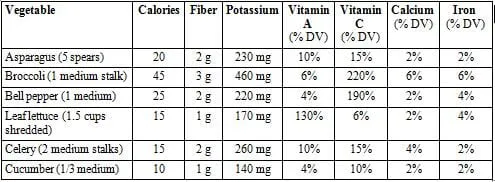
Nutritional Powerhouses
Pound for pound, calorie for calorie, green vegetables pack a nutritional wallop - just look at the nutritional profile for relatively small portions of these six popular green foods, courtesy of the Food and Drug Administration. (Note: DV = recommended daily value based on 2,000 calorie daily diet)
Note from Dr. Mha Atma: Dr. David Seaman is the author of the highly recommended (by me) new book The Deflame Diet, available at our office or at deflame.com.